This page is an educational guide, not a determination of your property rights. Our example illustrates one assumed allocation. Review the applicable method and legal characterization with your attorney.
Sample report · fictional data
See what an RSU apportionment report looks like
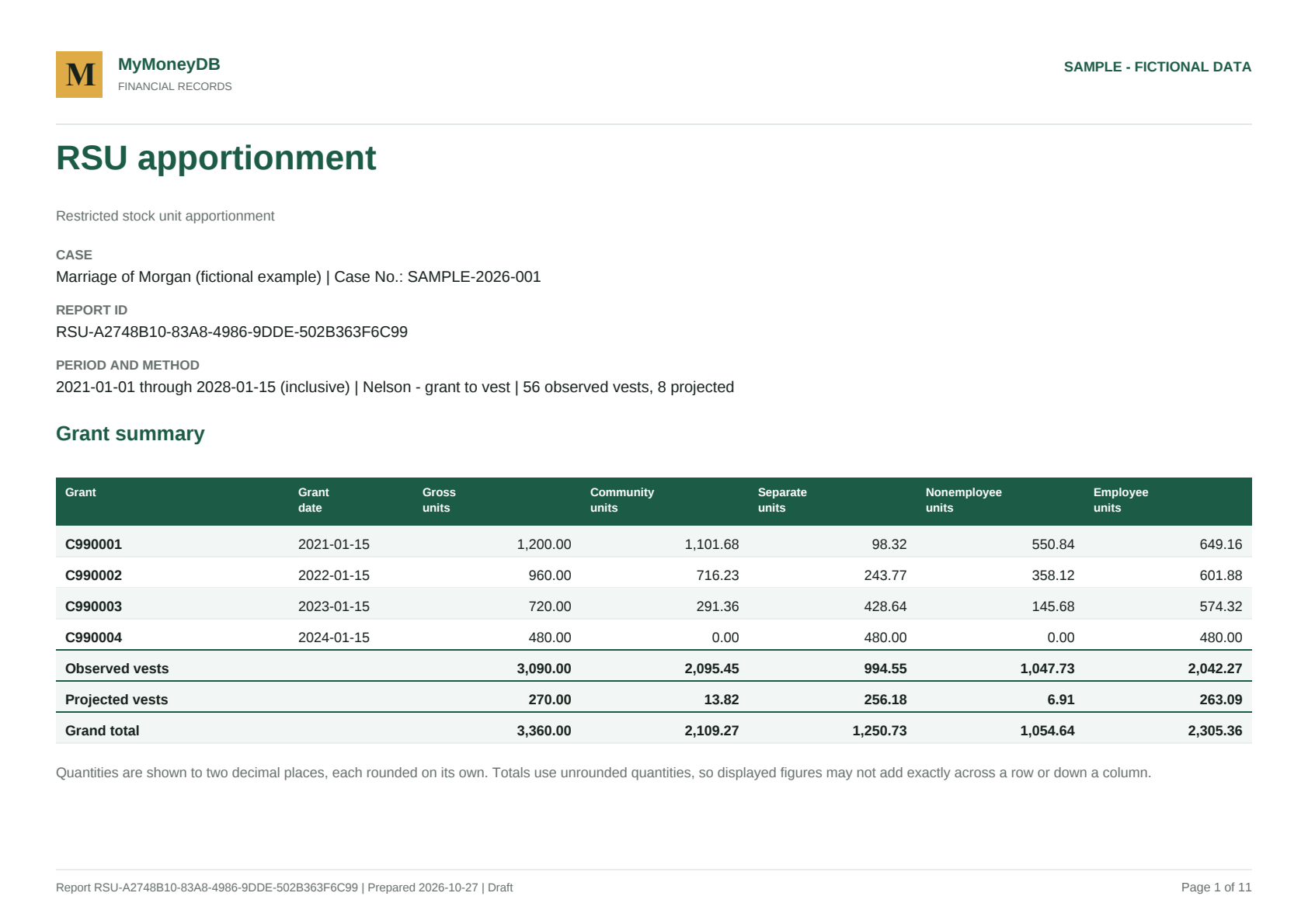
The first page summarizes four fictional grants and their proposed allocation. The complete example includes the methodology, recorded assumptions, detailed vesting schedules, and source-document references.
Get the full sample report
Enter your email to receive the complete 11-page RSU apportionment example. We may also reach out with a few questions about what you're looking for.
Check your inbox
We've sent a link to the full sample report to . If it doesn't arrive, check your spam folder.
No payment or case documents required. Privacy policy.
This is a draft example using fictional data, not an analysis of your equity or a legal determination.
What is being apportioned?
Restricted stock units (RSUs) are equity compensation awards representing a right to receive company shares or cash under the award's terms. RSUs may be unvested or vested but awaiting settlement. Once settled, the recipient holds the resulting shares or cash.
Vesting means the award's vesting conditions have been satisfied; settlement is the delivery of shares or cash. These events often happen together, but delivery can occur later under the plan's terms. Fidelity explains vesting and distribution. People often call the delivered shares their “RSUs”; “shares received from RSUs” is more precise.
RSUs differ from stock options, which give the holder a right to buy shares. Your award agreement and plan documents explain the conditions that apply to your particular grant. The IRS describes these equity compensation types.
In a divorce analysis, apportionment means calculating proposed community and separate portions under a specified approach. That calculation is distinct from deciding the legal character of the award, valuing it in dollars, and deciding how it will be divided.
California's general property framework distinguishes community property from separate property, and some assets have both components. California Courts explains that framework. Equity awards require attention to their own terms and facts.
Start with the records and dates
A useful worksheet identifies each grant and each vesting installment, rather than treating every award as one balance. Gather:
- Grant agreements and plan documents: grant identifiers, unit counts, conditions, and any explanation of the award's purpose.
- Vesting schedules and event records: scheduled and actual vesting, settlement, cancellations, and changes to the award.
- Employment and relationship dates: employment start, marriage, and the date of separation used for the analysis. Flag a disputed date instead of silently choosing one.
- Stock-plan, brokerage, and payroll records: gross units vested, shares withheld or sold, shares delivered, and transactions affecting the remaining holdings.
Keeping gross units and shares withheld separate makes the calculation easier to reconcile. An allocation of units is not, by itself, a tax calculation or a dollar valuation.
Choose the approach before calculating
You may encounter the names Hug and Nelson when discussing employee equity. These California cases involved stock options. The approaches they considered used different starting points for time-based apportionment, reflecting the circumstances and purpose of the awards.
Nelson explains that a single stock-option formula does not fit every case. Neither case supplies an automatic rule for every RSU grant. Applying an approach to your RSUs requires review of the award terms and the facts. Read the court's opinion in Marriage of Nelson.
A calculation should identify the selected service period, relevant dates, treatment of each installment, and any assumptions supplied for the analysis. When a method or date is disputed, comparing clearly labeled scenarios can show the financial effect without deciding the legal dispute.
A worked example under stated assumptions
Hypothetical · one vesting installment
Assume an installment contains 100 gross units. For this example only, the agreed method uses a 24-month service period, with 12 months attributable to the community. Also assume equal division of the calculated community portion.
Assumed community fraction = 12 ÷ 24 = 50%
Calculated community portion = 100 × 50% = 50 units
| Component | Calculation | Units |
|---|---|---|
| Community portion | 100 × 50% | 50 |
| Employee's separate portion | 100 − 50 | 50 |
| Other spouse's assumed share | 50 community units ÷ 2 | 25 |
| Employee's assumed total share | 50 separate + 25 community units | 75 |
The 25- and 75-unit figures divide the same 100 units; they are not additional to the community and separate rows. This is an arithmetic illustration, not a recommendation to use this method. It does not address withholding, taxes, valuation, transfer restrictions, forfeiture, or rounding. Different assumptions can change the result.
What makes an analysis traceable?
Each line should connect to a grant and vesting installment, identify its source document, show the calculation inputs and method, and distinguish documented facts from assumptions. Missing agreements, inconsistent counts, and unresolved dates should be flagged.
Keep characterization, allocation, valuation, and tax questions distinct. A clear worksheet helps you and your attorney review the numbers; it does not replace a legal decision, agreement, or court order.
If you explicitly request AI assistance and consent to the proposed use, AI can help structure statement data and automate characterization and allocation under stated assumptions. Read how we use AI. AI is optional.
Discuss your equity records
Tell us whether your question concerns grant records, vesting installments, or comparing allocation scenarios. We confirm fit and scope before requesting documents or beginning work. Please keep account numbers, documents, and sensitive financial details out of the initial inquiry.
Discuss your caseSources and scope
- California Courts: Property and debts in a divorce — general property framework.
- In re Marriage of Nelson (1986), 177 Cal.App.3d 150 — stock-option apportionment and discussion of Hug.
- IRS: Stock-based compensation types — RSU and stock-option definitions; its tax discussion concerns nonresident aliens and is not used here as tax advice.
- Fidelity: Restricted Stock Units — vesting and distribution, including deferred delivery.
Updated October 11, 2026. This guide addresses calculation concepts for California cases. It does not determine the appropriate treatment of a particular award.